





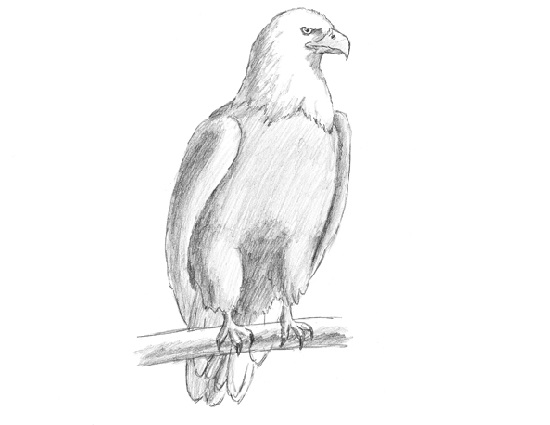
In just a few steps, you'll learn how to draw this Golden Eagle. All the tutorials on How2DrawAnimals are easy to follow and great for beginners and experienced artists alike. Get art basics while sketching your favorite animals step by step. Each free tutorial on this site has a video tutorial option, as well as step-by-step photos and written text to follow along with. Have fun drawing!
Stay tuned for more free drawing lessons by:
- Liking us on Facebook
- Subscribing on YouTube.com
- Following us on Instagram
This page contains Amazon affiliate links. If you choose to purchase through these links, I earn a small commission at no extra cost to you.
RELATED TUTORIALS
 |
 |
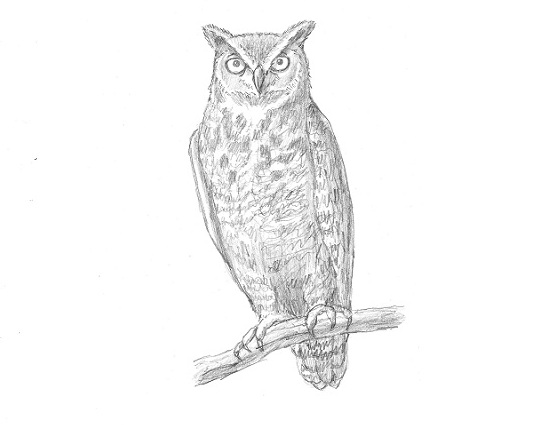 |
To draw this Golden Eagle step by step, follow along with the video tutorial below and pause the video after each step to go at your own pace. You may find it easier to follow the step-by-step images below the video. The new lines in each step are shown in red, so you'll know exactly what to sketch next. You may want to open the video in a new tab and use both drawing methods. Take your time and create art at your own pace.
Materials You’ll Need
Before starting, gather these basic drawing supplies:
- Pencil (an HB lead pencil is best for light sketches)
- Eraser
- Black ink pen or marker
- Drawing paper
- Colored pencils or markers
For the first few steps, don't press down too hard with your pencil. Use light, smooth strokes to begin.
Start with Simple Lines and Shapes

Step 1: Draw a big circle as a guide for the first part of the body. First draw four small marks to indicate the height and width of the circle, then connect the marks using curved lines. Sketch lightly at first so that it's easy to erase if you make a mistake. But the circle doesn't have to be perfect. It's just a guide. If you do want to draw a perfect circle, trace the outer rim of a cup, a lid or any other object with a circular edge.
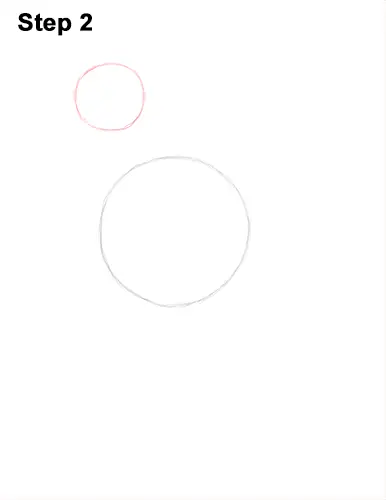
Step 2: Draw another circle on the top, left side as a guide for the head. Pay attention to the size of this circle in relation to the first one. It should be about one-fourth the size of the first one. Pay attention to the distance between the two circles as well. Don't place the head too far away from the body.
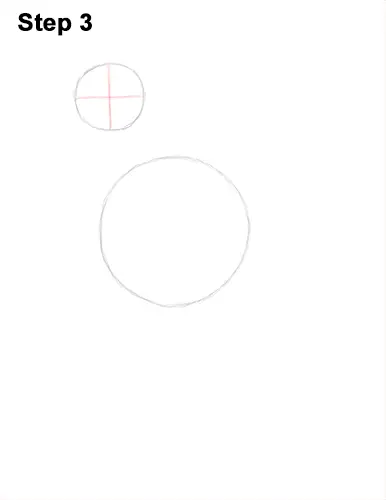
Step 3: Draw two intersecting lines inside the head to help you place the facial features later on. The end result should look similar to the scope of a lens.
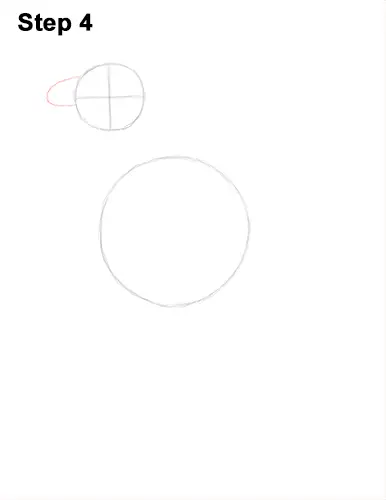
Step 4: Draw a small arc on the left side of the head as a guide for the beak. Pay attention to the size of this arc in relation to the rest of the head.
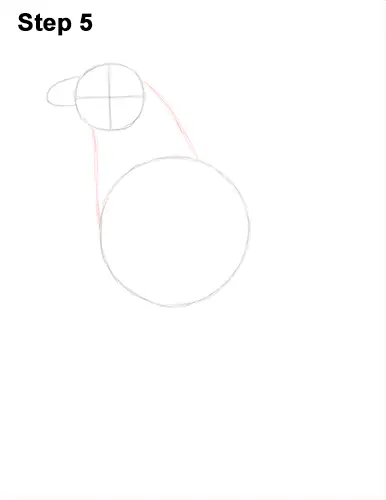
Step 5: Draw two curved lines that connect the head to the body to form the guide for the neck.
Keep Building the Guidelines Slowly
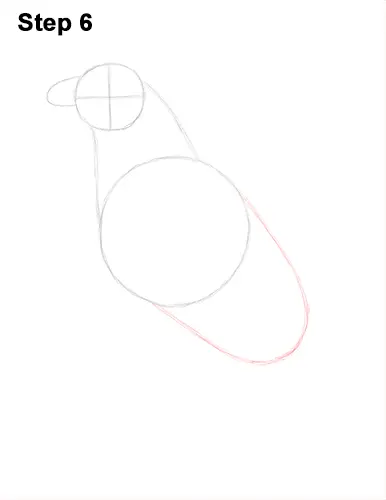
Step 6: Draw an arc on the lower right side of the first circle as a guide for the second part of the body. First draw a small mark to indicate the height of the arc, then connect the mark to the body using curved lines.
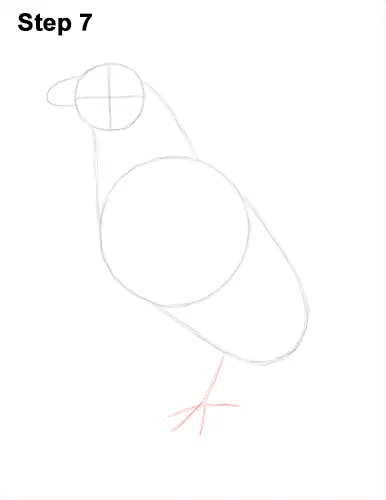
Step 7: Draw a long line under the body as a guide for the first leg. Add three more lines on the sides of the leg, near the bottom, as guides for the individual toes.
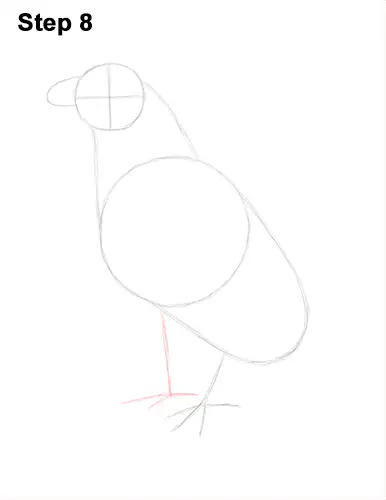
Step 8: Draw another line under the body on the left side as a guide for the other leg. Add three small lines at the bottom as guides for the individual toes.
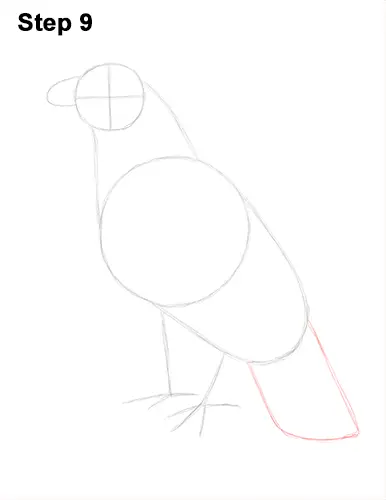
Step 9: Draw the guide for the tail on the lower right side of the body by first drawing two diagonal lines. Connect the diagonal lines at the bottom with a horizontal line to complete the guide for the tail.
Finish Up the "Skeleton"
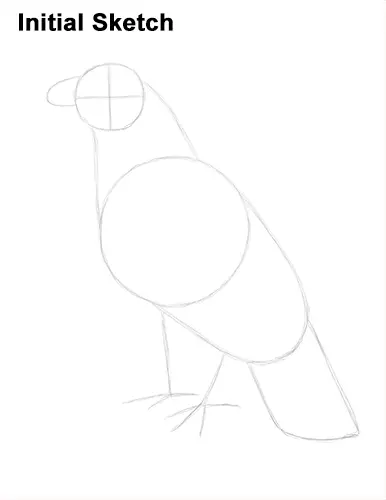
That's it for the initial sketch! From this point on, press harder with your pencil to get a more defined drawing.
Now Add Details
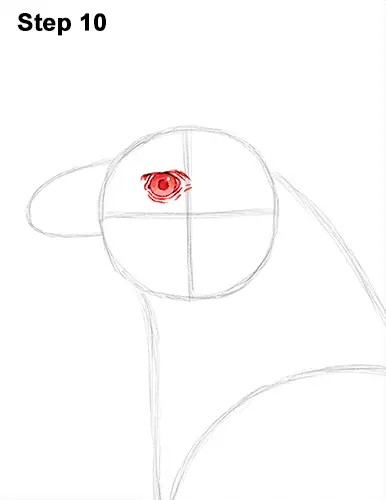
Step 10: Lightly sketch a small circle inside the head for the eye. Use the construction lines as guides for the placement of the eye. Draw a horizontal line above the small circle for the heavy brow. Darken the small circle to create the shape of the eyeball.
Add some curved lines on either side of the eyeball to complete the exterior shape of the eye. Add a series of lines around the eye for the wrinkles on the bare skin found there. Inside the eye, draw a tiny circle off to the side to represent glare. In the middle of the eye, draw a big dot for the pupil. Shade the inside of the eye using a value that's lighter than the pupil.
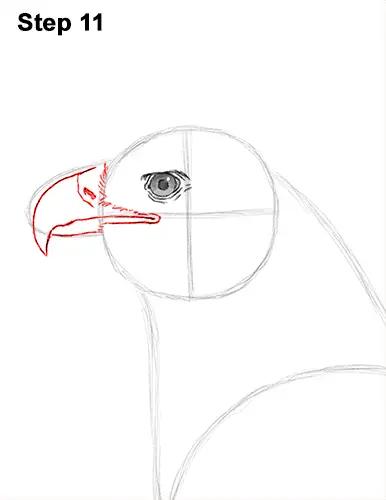
Step 11: Use the initial arc as a guide to draw the beak. Follow the path of the guide but make the beak a bit narrower. Continue drawing the line for the beak below the initial arc. Draw the hook of the beak outside of the arc and draw the mouth as a line that stretches toward the horizontal construction line under the eye.
Draw the bottom part of the beak by darkening the lower edge of the initial arc. Use a series of quick, short strokes to the right of the beak to draw its feathery base. Draw a straight line for the bottom part of the beak on the right side instead of quick, short strokes. Draw a short, thick line on the top part of the beak for the nostril. Add another line to the left of it for extra detail.
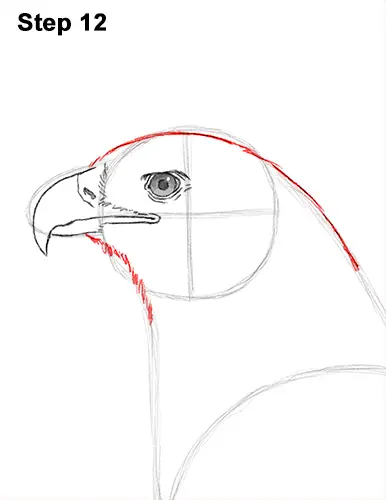
Step 12: Use the initial circle as a guide to draw the rest of the head. Simply follow the outer path of the guides and darken the lines to create the shape of the head. Use quick, short strokes as you follow the guide under the beak to create a feather-like texture on the neck. Continue to darken the line farther down than the initial circle to create the neck as well as the head.
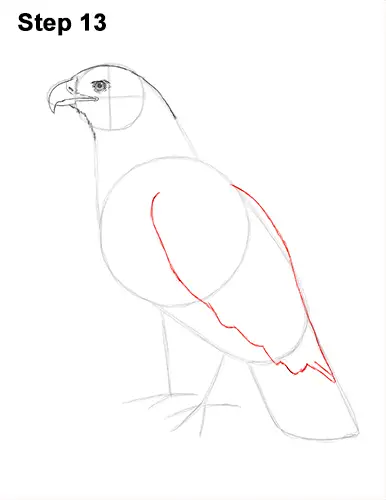
Step 13: Use the initial shapes and lines on the right side of the body as guides to draw the folded wing. Follow the basic path of the guides but make the wing bulge out a bit more at the top. Add a few V-shaped lines on the lower right side for the tips of the feathers on the folded wing. Draw a long, diagonal wavy line across the middle of the body for the inside edge of the folded wing.
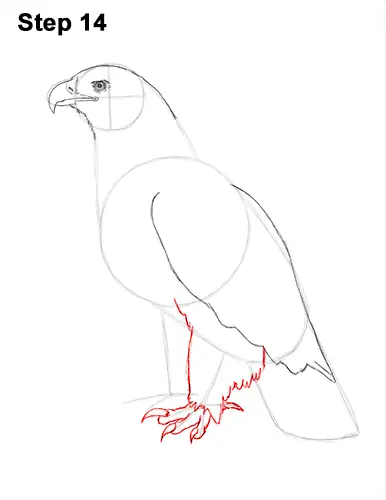
Step 14: Use the lines under the body on the right side as guides to draw the first leg. The shape of the leg should be thick at the top. The line for it should start under the very first circle from step 1. Add a few quick, short strokes at the bottom for the feathers, then curve the line back up and under the wing. Use the smaller lines at the bottom as guides to draw the individual toes and talons. Follow the basic path of the guides as you draw the shape of the toes around them. Draw the talons using a couple of curved lines. Eagles have massive talons, so don't draw them too small.
Stay Patient and Keep Drawing - You're Almost There!
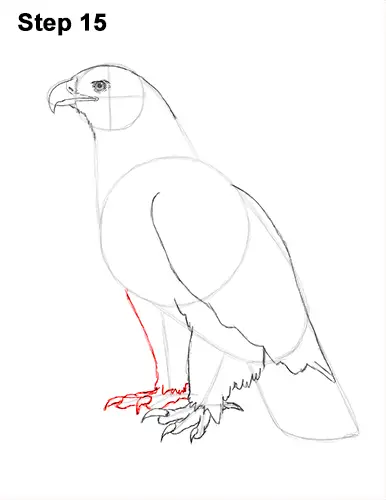
Step 15: Now draw the other leg by using the lines that are under the body on the left side as guides. Follow the basic path of the guide but make the shape of the leg thicker. Add some quick, short strokes at the bottom for the feathers. Use the smaller lines as guides to draw the individual toes and talons. The toes will overlap each other somewhat because of the perspective, so don't draw a couple of them.
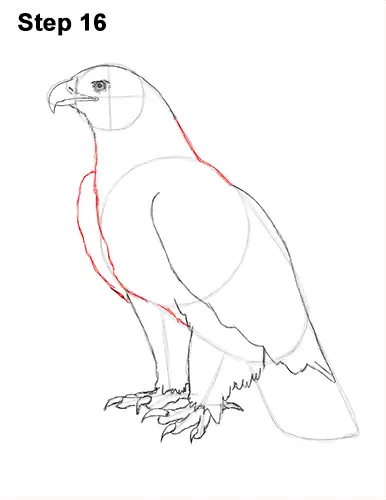
Step 16: Use the initial shapes and lines as guides to draw the shape of the body. Simply follow the path of the guides and darken their outer edges to complete the shape of the body. Draw a long curved line on the left side of the body for the other folded wing.
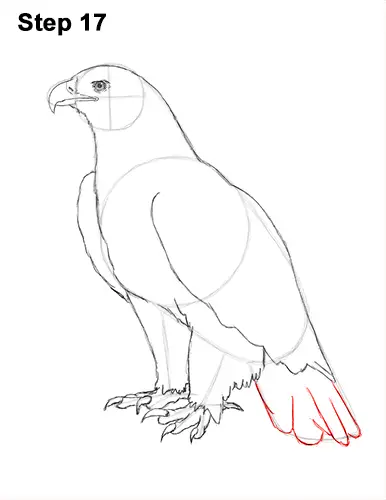
Step 17: Use the lines on the lower right side of the body as guides to draw the tail. Draw a series of long, thin, U-shaped arcs within the guides to represent the individual tail feathers.
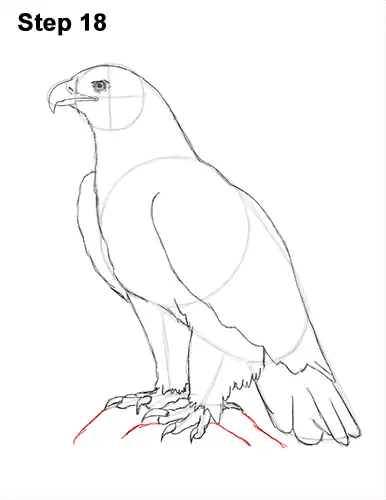
Step 18 (optional): Draw a couple of short curved lines under the feet to give the eagle something to stand on.
Now It's Time to Shade
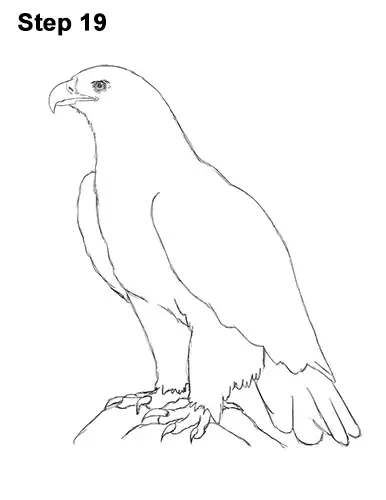
Step 19 (optional): For a cleaner look, erase as much as you can of the initial guide lines. Don't worry about erasing all of the guides. It's okay to leave some behind. Re-draw any final sketch lines that you may have accidentally erased.
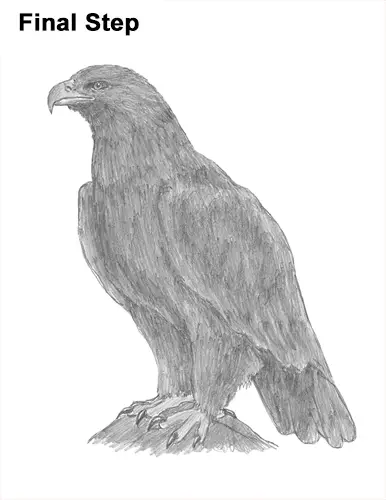
Final Step (optional): Add some shading throughout your drawing for extra detail. These birds are basically a solid brown color with very little pattern, so simply add a medium value to your whole drawing. As you shade, use strokes that go in the general direction of the feathers. Use strokes with a horizontal orientation on the head, then gradually turn them so that they're vertical on the body. You can also leave the head and tail blank and turn this into a bald eagle!
As you shade, make the lower edges of the individual shapes darker to give the body more dimension and volume. Vary the pressure on your pencil to get different degrees of tonal value. Add the value lightly at first, then gradually build up to the level of darkness that you want. Shading can be very time-consuming, so be patient and take breaks.
Use different degrees of value on the bottom edge of the folded wing to represent the individual feathers. Continue shading until the entire body is covered in value. You can shade different sections at a time to break up the process. It's always a good idea to use reference as you draw. And remember to pause the video to draw at your own pace.
Buy My Step-by-Step Art Books on Amazon!
If you enjoyed drawing with me and want to expand your artistic skills, please consider checking out my step-by-step drawing books on Amazon! My books break down a wide variety of animals into simple geometric shapes, making it easy and fun for artists of any skill level to follow along. Every purchase directly helps support this site so I can keep creating high-quality, free tutorials for the art community.
Click Here to Order Your Copy Today!
Thanks for watching! Subscribe to the How2DrawAnimals YouTube Channel for a new tutorial every Tuesday.
To learn how to draw popular cartoon characters, visit EasyDrawingTutorials.com.
RELATED TUTORIALS
|
|
|